AI Chatbot vs Live Chat vs Contact Forms: What Works Best for Small Business?
A practical comparison of AI chatbots, live chat, and contact forms — covering availability, cost, response time, and conversion — with clear recommendations for Australian SMEs.
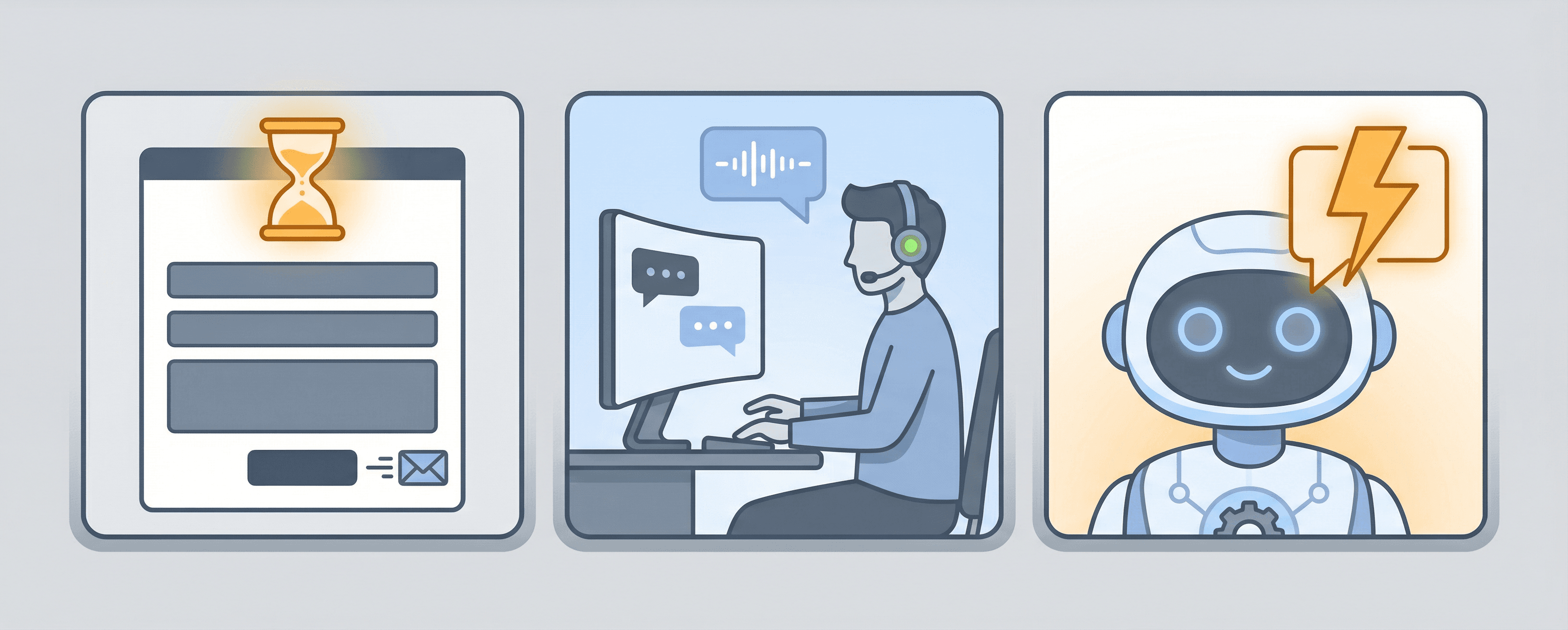
When a visitor lands on your website and has a question, you have three main options for how they can get in touch: an AI chatbot, a live chat system with a human agent, or a traditional contact form.
Each has different strengths, costs, and ideal use cases. This guide compares all three honestly — so you can choose the right combination for your business.
At a glance
| AI Chatbot | Live Chat | Contact Form | |
|---|---|---|---|
| Availability | 24/7 | Business hours (or costly) | 24/7 |
| Response speed | Instant | 1–5 minutes | Hours to days |
| Cost | Low fixed cost | Ongoing staff cost | Free (built in) |
| Conversion rate | Medium–High | High | Low |
| Setup complexity | Medium (1–2 hours) | High (ongoing management) | Low |
| Lead capture | Yes (automated) | Yes (manual) | Yes (form data) |
| Handles complex queries | Partial | Yes | No |
| Scales with traffic | Yes | No | Yes |
Contact forms
How they work
A contact form is a simple form on your website — usually with name, email, and a message field. Submissions land in your inbox.
Pros
- Free to set up
- Available 24/7 (form takes submissions anytime)
- Simple for visitors who are already committed to making contact
- No ongoing management required
Cons
- No immediate response — visitors wait hours or days
- High abandonment — many visitors won't bother filling in a form
- No qualification — you receive raw messages with no pre-screening
- No conversation — no ability to guide the visitor or ask clarifying questions
- Poor conversion — visitors who have a quick question often leave rather than filling in a form
When contact forms work best
Contact forms are fine as a fallback option — something to use alongside other channels. They're not effective as a primary enquiry mechanism for businesses that compete on responsiveness.
Live chat
How it works
Live chat connects a website visitor with a real human agent in real time. The agent responds manually, usually via a dashboard or app.
Pros
- High conversion — human connection builds trust quickly
- Can handle complex, nuanced queries
- Flexible — can escalate to a call or video if needed
- Great for high-stakes sales conversations
Cons
- Expensive — requires a dedicated person (or team) monitoring chat during hours
- Limited availability — most live chat is only available business hours
- Doesn't scale — one agent can handle one conversation at a time
- Response time varies — if the agent is busy, wait times increase
- High staff turnover — live chat agents need ongoing training and management
Cost reality for Australian SMEs:
Hiring a part-time person to manage live chat costs $20–$30/hour plus super. That's $800–$2,400/month for even a basic coverage window. Out of reach for most small businesses.
Third-party live chat services (offshore agents) cost less but introduce quality risks — agents who don't know your business well can give wrong answers or create a poor impression.
When live chat works best
Live chat is best suited for high-value transactions where the human element closes the deal — think luxury retail, complex B2B sales, or high-ticket services. It's not cost-effective for businesses with moderate traffic and moderate-value transactions.
AI chatbots
How they work
An AI chatbot is trained on your business content (website, documents, FAQs) and handles conversations automatically. It understands natural language questions and responds with relevant information.
Pros
- Available 24/7 with instant responses
- Low fixed cost (compared to live chat staffing)
- Scales to unlimited simultaneous conversations
- Captures lead details automatically
- Consistent — every visitor gets the same accurate answer
- Improves over time as you refine training data
Cons
- Can't handle highly complex or emotional queries
- Requires setup and ongoing maintenance
- Won't fully replace human judgment in nuanced situations
- Some customers still prefer a human
When AI chatbots work best
AI chatbots excel for businesses where:
- Enquiries follow predictable patterns (trades, local services, clinics, retail)
- Volume is high but staff availability is limited
- After-hours coverage is important
- Lead capture is a priority
- Budget doesn't allow for live chat staffing
The hybrid approach (recommended)
For most Australian SMEs, the best setup combines all three channels:
- AI chatbot — primary channel, handles 24/7 enquiries, captures leads, answers FAQs
- Contact form — fallback for visitors who prefer it or for longer messages
- Live chat (optional) — enabled during business hours for high-value sales conversations, if budget allows
This gives you full coverage without requiring a full-time support person.
Which to prioritise if you're starting fresh
If you have a limited budget: Start with a contact form (already on your site) and add an AI chatbot. Skip live chat until revenue justifies the staffing cost.
If you have moderate budget: AI chatbot + contact form + look at a tool like Crisp or Tidio that lets you handle live chat during business hours when you're available.
If you're in a high-ticket service business: AI chatbot for initial qualification + live chat during business hours + phone for complex enquiries.
Pivra's approach
Pivra focuses on the AI chatbot layer — the 24/7, automated, lead-capturing side of the equation. It's built for Australian SMEs who need first-contact automation without the cost of live chat staffing.
The free plan lets you test whether it works for your business before spending anything.
Try Pivra free — one chatbot, 500 messages/month, live in under an hour.
Author
The Pivra Team
Pivra
The Pivra team writes from product, onboarding, and customer support work with Australian tradies, local services, and small business operators.